
Established fact Tradition
-
Established fact — 1st century
The Acts of the Apostles introduce “John, also called Mark” in Jerusalem, in the house of his mother Mary where the community gathers to pray.
Read -
Tradition — c. 49
Eusebius of Caesarea places Mark's arrival in Alexandria and the founding of the local church. No New Testament text mentions this Egyptian stay.
Read -
Established fact — 65-75
Dating range held by the majority of specialists for the writing of the Gospel according to Mark, with a growing preference for after 70.
Read -
Tradition — 68
Year of the martyrdom in Alexandria generally held. The account — the rope, the nocturnal apparition, the storm — comes from the Acts of Mark, written several centuries later.
Read -
Established fact — early 2nd century
Papias of Hierapolis makes Mark the interpreter of Peter. His work is lost: the fragment is known only through the quotation Eusebius makes of it two centuries later.
Read -
Established fact — c. 180
Irenaeus of Lyons is the first to link the four living creatures to the four gospels — but he attaches the lion to John, and the eagle to Mark.
Read -
Established fact — late 4th century
Jerome fixes the distribution that would prevail in the West: the lion falls to Mark.
Read -
Established fact — 470
Saint Mamertus, bishop of Vienne, institutes the Minor Rogations, celebrated on the three days preceding the Ascension.
Read -
Established fact — c. 604
The Litania Major of 25 April, inherited from the Roman Robigalia, is attested as an established practice under Gregory the Great.
Read -
Established fact — 827-829
The will of a doge attests the presence of the relics in Venice — a real documentary anchoring, two centuries earlier than the first written account of the transfer.
Read -
Tradition — 828
Buono da Malamocco and Rustico da Torcello steal the body from Alexandria, hidden under cabbage leaves and cuts of pork to discourage the customs officers.
Read -
Established fact — 829-836
Construction of the first church of Saint Mark, conceived as the doge's private chapel and not as an episcopal church.
Read -
Established fact — 976
The revolt against the doge Pietro Candiano IV turns into a fire and destroys the church, the ducal palace and nearly two hundred houses.
Read -
Established fact — c. 1063
The doge Domenico Contarini launches the building of the present basilica, on a Greek-cross plan, inspired by the Holy Apostles in Constantinople.
Read -
Established fact — 1071
Venice makes Saint Mark its principal patron saint.
Read -
Tradition — 25 June 1094
Inventio Sancti Marci: after a fast decreed by the doge, a transept pillar is said to have cracked of its own accord, revealing an arm of the saint.
Read -
Established fact — 12th century
The bronze lion takes its place at the top of one of the two columns of the Piazzetta.
Read -
Tradition — 13th-14th century
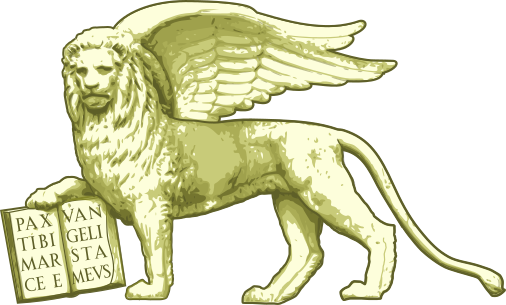
The Venetian chroniclers fix the legend of the angel and of “Pax tibi Marce” — a predestination written after the fact, which turns a theft into a promise kept.
Read -
Established fact — 1835
The relics leave the crypt, too damp, for the presbyterium, beneath the high altar, where they still are.
Read -
Established fact — June 1968
Paul VI returns to the Coptic Orthodox Church a bone fragment taken from the body preserved in Venice; Saint Mark's Cathedral in Abbassia is consecrated on 25 June.
Read -
Established fact — 2024
Isotopic analyses show that the bulk of the bronze of the Piazzetta lion comes from the lower Yangtze basin, probably cast under the Tang dynasty.
Read