
- 828
- Translation of the relics from Alexandria to Venice
- 829-836
- First church of Saint Mark, private chapel of the doge
- 976
- Fire of the revolt against Pietro Candiano IV
- 25 June 1094
- Inventio Sancti Marci; consecration of the basilica
- 1835
- The relics transferred beneath the high altar
Key facts
A city in search of a saint to match it
Before 828, Venice prayed under the protection of Saint Theodore of Amasea, a Greek officer martyred in the fourth century — a solid saint, but Byzantine to the bone, like the tutelage the young lagoon city was precisely seeking to shake off. His statue still watches over the Piazzetta, on one of the two columns, facing a rival who was soon to supplant him.
In the ninth century, Venice is playing a tight game on three fronts at once: loosening the nominal grip of Byzantium, resisting the claims of the patriarchate of Aquileia, which had just, in 827, reasserted its authority over the region, and keeping its distance from Rome. A military martyr-saint like Theodore was no longer equal to that ambition. What was needed was an apostle — a figure of higher rank, come from the East without owing its legitimacy either to Constantinople or to the pope. Mark the Evangelist, legendary first bishop of Alexandria, dead in 68 according to tradition and buried in the Coptic church of Bucoles, had exactly that profile. By appropriating his relics, Venice was giving itself the equivalent of a founding charter, religious and political, cut to measure. The consequence has crossed the centuries: Saint Mark’s basilica never depended on the Venetian bishopric nor on Rome; its clergy was appointed by the doge, not by a bishop. Saint Mark became the saint of a civil power, not of a local Church.
The theft of the relics
In 828, a flotilla of ten Venetian merchant ships puts in at Alexandria, then a Muslim city under the Abbasids. Two merchants, Buono da Malamocco and Rustico da Torcello, make their way to the church of Saint Mark, where the saint’s body rests under the guard of two monks, Theodore and Stauracius.
The episode is “as much a matter of politics as of piety”.
Donald Nicol, historian

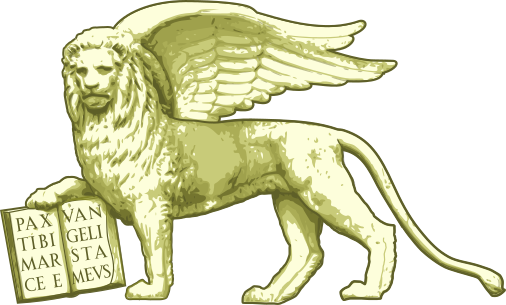
The angel, the storm, and “Pax tibi Marce”
Pax tibi Marce, evangelista meus. Hic requiescet corpus tuum.
Peace to you, Mark, my evangelist. Here shall your body rest.
Legend of the praedestinatio, Venetian chroniclers of the 13th-14th centuries
From ducal chapel to basilica
On the arrival of the relics, the doge then in office, Giustiniano Participazio, first has them kept in the ducal palace. In his will, he asks that his wife and his brother and successor, Giovanni I Participazio, have a church built dedicated to Saint Mark between the fortified core of ducal power and the pre-existing church of Saint Theodore. The works, begun in Giustiniano’s lifetime, are completed under Giovanni, between 829 and 836 according to the sources. This first church, cruciform in plan, is conceived as the doge’s private chapel and not as an episcopal church — a status of exemption it has kept to this day: it would become the cathedral of the patriarchate of Venice only in 1807, under the Napoleonic administration.
The building would not come through unscathed. In 976, a popular revolt against the doge Pietro Candiano IV turns into a fire and destroys the church, the ducal palace and nearly two hundred houses round about. The reconstruction, carried out the same year by Pietro Orseolo, remains modest. It is almost a century later, around 1063, that the doge Domenico Contarini launches the ambitious project that would produce the basilica we know: a Greek-cross plan inspired by the Holy Apostles in Constantinople, the old chapel of Saint Mark reduced to the rank of crypt beneath the new building. The consecration takes place in 1094.
The fire, the rediscovery, and the resting of the relics

La Festa del Bocolo
25 April, Saint Mark’s day in the liturgical calendar, coincides in Venice with Liberation Day, shared by the whole of Italy — and with a tradition all its own, the Festa del Bòcolo, “feast of the rosebud” in Venetian dialect. On that day, men give a red rose to the women who matter to them: wife, fiancée, mother, sister.
The most widespread origin of this custom has, this time, nothing to do with the translation of the relics: it is the story of Maria, daughter of the doge Angelo Participazio, in love with the troubadour Tancredi. Gone to fight at Roncevaux, Tancredi is said to have been mortally wounded there beside a rosebush; he is said to have dyed a white rose with his own blood before having it carried to Maria by a companion-in-arms. She is said to have died of grief on 25 April, the scarlet rose laid on her heart. A second tradition, less well known, ties the bòcolo more directly to Saint Mark, by way of a rosebush grown near his tomb and given to a sailor named Basilio. Neither of these stories stands up to historical verification — they belong to Venetian folklore, set down in writing at a late date. If the feast remains associated with Saint Mark, it is above all through the coincidence of the calendar: 25 April is, quite simply, the day of his liturgical feast.
Sources
- Saint Mark's relics — Wikipédia (anglais)
- Basilique Saint-Marc de Venise — Wikipédia (français)
- Pouvoir et politique des reliques dans la Venise médiévale — revue Pallas (OpenEdition Journals)
- How Venice Stole St Mark's Relics From Alexandria — Inside the Lagoon
- 828, le rapt des reliques de saint Marc — Le Journal des Arts
- Translatio Marci Evangelistae Venetias (texte, traduction anglaise) — History Walks in Venice
- Lion de saint Marc — Wikipédia (français)
- 25th of April: Venice and the Festa del Bocolo — L'Italo-Americano
- Bòcolo di San Marco, la vera storia — Serenissima News