
- c. 593 BC
- Vision of the four living creatures in Ezekiel
- c. 180
- Irenaeus of Lyons links the four living creatures to the gospels
- late 4th century
- Jerome fixes the lion for Mark
- 12th century
- The bronze lion in place on the Piazzetta
- 2024
- Isotopic analyses: bronze from the lower Yangtze, Tang casting
Key facts
The tetramorph: Ezekiel’s vision and the Book of Revelation
Look closely at a Byzantine mosaic, a Romanesque portal or a page of an illuminated gospel book: there is a good chance that a winged lion will be found there alongside an ox, a man and an eagle, all four furnished with wings and arranged in a crown around a central figure. This composition, called the tetramorph, goes back to two biblical visions seven centuries apart. Around 593 BC, in exile in Babylon, the prophet Ezekiel sees rising out of the fire four living beings at once men, lions, oxen and eagles — cherubim, says the text, associated with the very throne of God. Six centuries later, the Revelation of John takes up the scene around the heavenly throne, but simplifies the figure: each creature now bears only a single face, one leonine, another bovine, the third human, the last aquiline. It is this pared-down version, far more workable for sculptors and illuminators, that prevails in Christian art and gives rise to the tetramorph as we still look at it today.
Why the lion falls to Mark (the traditional explanations)
Wings, book open or closed: reading the iconography
A winged lion exists in no zoology: that is precisely the signal to look for, on a mosaic or a bas-relief, in order to recognise that one is dealing with a theophanic symbol and not with an ordinary animal figure. The wings come straight from the biblical vision, where they marked the heavenly nature of the cherubim; applied to Mark’s lion, they transpose that same supernatural dimension onto the text of the gospel.
The rest of the iconography reads almost like a code. The lion may be couchant, in a guarding position — frequent in Byzantine and Romanesque art — or standing and walking, notably in late Venetian heraldry. Beneath its paw, a book: open, it announces peace; closed, war — a nuance whose political meaning unfolds fully in Venice. A halo, when present, recalls that beyond the political emblem, this is first of all a symbol of evangelical holiness.
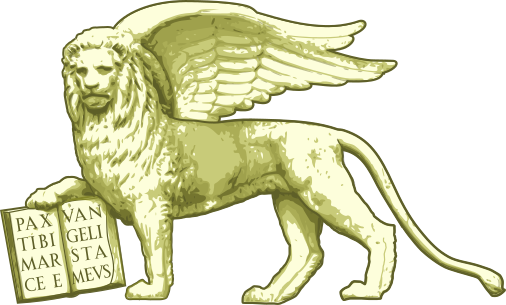
“Pax tibi Marce” and the lion of the Republic of Venice
Pax tibi Marce, evangelista meus. Hic requiescet corpus tuum.
Peace to you, Mark, my evangelist, here shall your body rest.
Inscription on the open book held by the lion
This legend of the praedestinatio, without historical foundation, nevertheless produced quite real effects: it served as justification for the theft of Mark’s relics from Alexandria in 828, and then for the saint’s elevation to the rank of patron of the city. The formula, inscribed in capital letters, can still be read on the pages of the book held by the lion in almost all official Venetian representations — seals, coins, palace façades, gonfalons.
Venetian heraldry distinguishes two postures that are readily identifiable on the ground. The “andante” lion, in profile, one paw on the book, adorns statues, gonfalons and pediments — it is the ambassadorial form, cut to be seen from afar. The “in moleca” lion, facing front, compact, wings spread in a crown in the manner of a soft-shell crab, is found rather on seals, coins and communal coats of arms, more closely associated with the lagoon itself.
The bronze lion of the Piazzetta and the traces of the Serenissima
Beyond the Piazzetta, the Marcian lion has left its imprint across the whole Venetian Mediterranean: some thirty lions survive at Koper, in Istria, others at Poreč, Rovinj or Motovun; a lion still overlooks the Acropolis of Corfu; Heraklion, Chania and the Othello fortress at Famagusta likewise bear the mark, while at Split some of the lions were chiselled away during the Yugoslav period.
The tetramorph beyond Venice
The heraldic and political destiny of the Venetian lion should not make us forget that the complete tetramorph remains, first and foremost, a motif of Christian art as a whole — particularly in scenes of Maiestas Domini, Christ in glory enthroned in a mandorla, surrounded by the four living creatures. The great tympanum of the abbey church of Moissac, carved at the beginning of the twelfth century, offers one of its most striking Romanesque versions; the royal portal of Chartres cathedral, a few decades later, takes up the same structure in a more hieratic style. In the Carolingian and Ottonian gospel books as in the Book of Kells, each evangelist appears in bust form accompanied by his symbol. Mark’s winged lion is therefore only one of the four elements of a far vaster system — before Venice, centuries later, isolated a single figure from it to make it the emblem of its maritime identity.
Sources
- Tetramorph — Wikipedia
- Irenaeus of Lyons, Against Heresies, Book III (trad. Roberts-Donaldson)
- Symbols of the Four Evangelists — Catholic Resources (Felix Just, S.J.)
- Medieval Bestiary: Lion
- Lion of Saint Mark — Wikipedia
- Flag of the Republic of Venice — Wikipedia
- The Lion of St. Mark's Square in Venice is Chinese: Isotopic Analyses Confirm It — Archaeology News Online Magazine
- Made in China? The Asian origins of Venice's iconic Winged Lion statue — Antiquity Journal
- Saint-Pierre, Moissac — Survey of Art History Western Tradition